News
How to Build Confidence as a Founder: Lauren Currie OBE on Taking Action Before You Feel Ready
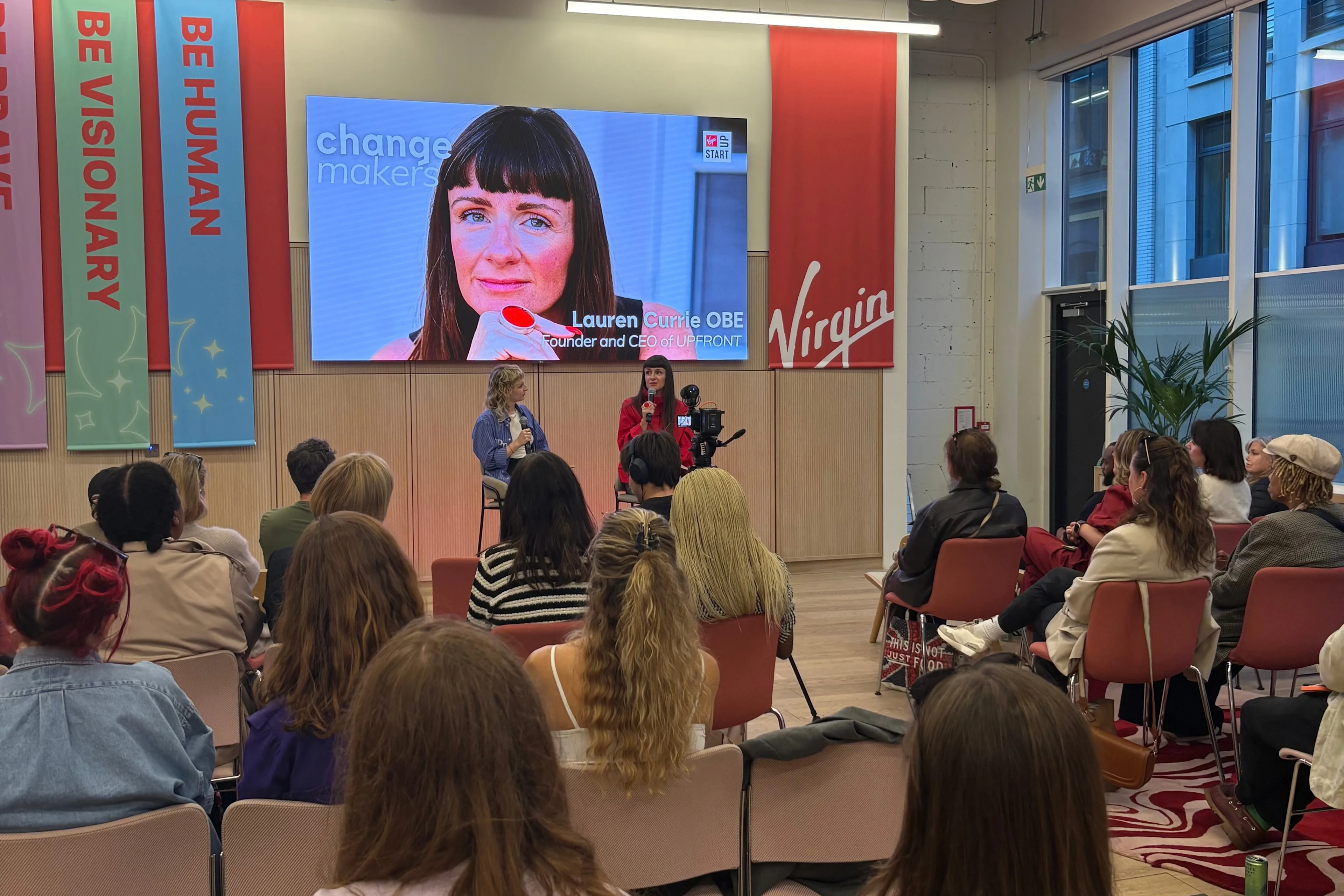
Back to NewsAt our latest Changemaker event, we welcomed Lauren Currie OBE, founder and CEO of UPFRONT, to Virgin HQ for a conversation about confidence, entrepreneurship, visibility and challenging the rules that hold us back.
Lauren is a six-time founder, bestselling author, artist and speaker. Through UPFRONT, she has supported more than 17,000 leaders across over 50 countries and worked with organisations including Nike, Just Eat Takeaway, the Ministry of Defence, British Red Cross and Pleo.
You could look at that list and assume confidence has always come naturally.
Lauren would tell you otherwise.
For her, confidence isn't a personality trait or a destination you eventually reach. It's a skill. And you build it by doing things before you feel completely ready.
Confidence is a muscle you build by taking action
Lauren never planned to become an entrepreneur.
At 13, an art teacher showed her another student's redesign of a TV remote control to make it easier for someone with arthritis to use. It changed how she saw the world. Suddenly, she understood that almost everything we interact with has been designed by somebody, and that design could be used to make people's lives better.
Lauren went on to study product design, and it was her design education that helped shape the way she approaches business today. With product design, the goal wasn't to spend months making something perfect.
It was to find the scrappiest, easiest way to turn an idea into something real. Test it. Learn from it. Then either develop it or move on.
Lauren calls herself someone with a strong bias towards action, and that approach has become fundamental to the way she thinks about confidence. Because confidence, she explained, isn't something you wait for. You build it by doing.
Treat your business like a prototype
For founders delaying an idea because it isn't quite ready, Lauren's design mindset offers a useful alternative.
Everything can be a prototype. When Lauren has an idea, she might sketch it on a piece of paper, photograph it and send it to five people. Within minutes, she can begin learning whether there's something worth pursuing or whether she simply got carried away by an exciting thought.
She applies the same thinking to much bigger decisions too. When her family moved to Sweden, rather than treating it as an enormous irreversible decision, they treated it as an experiment.
What would make this safe to try?
What would tell us it isn't working?
What would we do next?
Lauren applies the same question to business decisions. "Safe to try" doesn't mean risk-free.
Every founder gets to decide what level of risk is acceptable for them. But it turns the question from "Am I certain this will work?" into something much more useful: "Is this safe enough to test?"
UPFRONT started without a business model
The story of UPFRONT is itself a great example. In 2015, Lauren was speaking at a design conference in Bristol and found herself, once again, the only woman on the speaker line-up.
She had become frustrated by seeing the same pattern repeatedly. So she did something about it. Lauren placed a Post-it note on the mirror in the women's toilets asking whether anyone wanted to speak on stage one day.
The response helped her uncover something deeper. Women weren't simply being overlooked. Many had internalised the belief that stages weren't places for people like them. Others wanted to speak but didn't know where they could practise safely. Lauren decided to create that opportunity.
She started taking a red sofa on stage when she spoke and inviting women and people from underrepresented groups to simply sit there with her. No speech required. They could experience being on stage, sit with the discomfort and discover that it wasn't as terrifying as they imagined.
The idea spread.
For a long time, there was no business model. Lauren's mum was making UPFRONT cushion covers that were posted around the world so other speakers could recreate the idea.
Eventually people started asking Lauren for workshops, courses and other ways to learn. She listened. Small Saturday workshops followed, then businesses began asking for them too. Slowly, an experiment became UPFRONT.
Challenge the rules your business was built to break
Another major theme of Lauren's conversation was rules. Not the rules that keep people safe, but the invisible rules we inherit about who gets to lead, how businesses should operate, and what success is supposed to look like. Lauren encourages people to approach those rules with curiosity.
Who created this rule?
Who benefits from it?
And what happens if we challenge it?
That mindset matters commercially too.
For Lauren, founders who question established ways of doing things can spot opportunities for innovation that others miss.
Every founder can ask themselves: what is the rule my business exists to challenge?
Build the change you want to see into your company
Lauren doesn't believe a business should only create change through the product or service it sells. The business itself can become a prototype for that change.
At UPFRONT, that philosophy influences how the company works, from salary transparency on job adverts and company-paid therapy to creating a workplace that recognises people have families and lives outside work.
Lauren questions traditional workplace structures because many were created around a very different model of working life. Instead of automatically replicating them, UPFRONT asks what work needs to look like for the humans actually doing it.
For founders building teams, it's an opportunity that's easy to underestimate. You don't just get to decide what your company sells, you get to decide what kind of company it becomes.
Self-doubt doesn't mean you're in the wrong room
Lauren also challenge the way we talk about imposter syndrome. She doesn't dismiss the feeling of being an imposter. That feeling can be very real.
But she questions whether describing it as a "syndrome" helps.
Sometimes you feel like you don't belong because you're operating in a space that wasn't designed with someone like you in mind. You might be the first person with your background in the room. You might look or sound different. You might be challenging an established system.
Feeling uncomfortable in that situation doesn't necessarily mean you're unqualified to be there.
Lauren takes a similarly different view of self-doubt. Rather than something founders need to eliminate, self-doubt can be evidence that you care. It appears when the stakes are high.
The goal isn't necessarily to stop doubting yourself. It's to reach a point where the doubt doesn't stop you taking action.
Visibility isn't just about social media
For founders, confidence and visibility often go hand in hand. But Lauren was keen to point out that visibility doesn't have to mean constantly posting online.
Her own journey started under a pseudonym, Red Jotter. She spent years building her work before becoming comfortable putting herself at the centre of it.
What matters is finding ways to make your work visible.
Lauren described everything she shares as a grain of sand. One post might get ignored, an idea you've spent hours creating might barely be seen. But another could reach the one person who sends an email, opens a door, or creates an opportunity you couldn't have predicted.
Over time, those grains of sand become a beach: a visible body of work that demonstrates what you believe, what you know and what you've built.
You don't need every piece to perform. You need to keep showing your work.
Find people who make you think bigger
Lauren was also candid about the ways she has limited herself.
UPFRONT is her sixth business, but the first she has built without a co-founder. Looking back, she realised that for years it hadn't occurred to her that she could build a company alone.
Even now, she knows there will be limits she's placing on herself that she can't yet see. That's why she deliberately surrounds herself with what she calls "believing mirrors". These are people who recognise what you've achieved, but can also reflect a bigger possibility back at you.
Lauren created an Advisory Council for UPFRONT made up of experienced people from different industries who meet quarterly and challenge her thinking. They can tell her when she needs to play bigger, when something doesn't fit, or when she's underestimating an opportunity.
For founders who don't already have entrepreneurs or business leaders in their personal networks, Lauren encouraged deliberately seeking those people out.
Sometimes you need someone else to ask: What if this was ten times bigger?
Ask for what you need
That same principle came through when Lauren was asked how to build a network somewhere new. Her answer was practical:
Be intentional.
Ask people directly for introductions.
Ask, "Who do you know that I should know?"
Create something small that gives people a reason to come together.
Document what you're doing so relevant people can discover you.
Make yourself visible.
Lauren used exactly this approach when building a network in Sweden and again after returning to Scotland. Networks don't always appear organically. Sometimes you have to build them on purpose.
Final Thoughts: What Founders Can Learn
Lauren's journey offers a different way of thinking about confidence. You don't need to become fearless before you start a business, launch an idea, speak publicly, or ask for something bigger. You build confidence through doing those things. Here are 9 lessons that stood out:
Treat confidence as a practice, not a personality trait.
Make the distance between idea and experiment as small as possible.
Instead of asking whether an idea will definitely work, ask whether it's safe to try.
Challenge the invisible rules everyone else has accepted.
Don't mistake self-doubt for evidence that you don't belong.
Make your work visible, even when it feels like nobody is paying attention.
Ask directly for introductions, opportunities and support.
Find people who reflect your potential back at you and encourage you to think bigger.
When you reach another uncomfortable stage of growth, don't immediately assume something has gone wrong.
As Lauren reminded one founder in the room, sometimes it feels uncomfortable because you're about to level up.
You don't need to know exactly how you'll do the next thing yet. You can learn, you can ask for help, and you can start before you feel confident.
Come along to Our Next Changemakers Event
Changemakers is a Virgin StartUp event that takes place every month at Virgin HQ and is free to attend.
It's a chance to hear honest stories from people building businesses and creating change, ask the questions you actually want answered, and connect with other founders navigating the same highs, lows and leaps into the unknown.
Join the Virgin StartUp Community to stay updated on upcoming Changemaker events and secure your place.
See you there!
- Written by Nina Evangeli, Virgin StartUp